


MVP VS MLP
How Much Product Should a Startup Actually Launch With?
- August 26, 2026
- By the Devsynth engineering team
- Reading time ~9 min
Key takeaways
- A minimum viable product (MVP) is the smallest build that tests whether your core idea is true. A minimum lovable product (MLP) is the smallest build that people actually enjoy using, not just tolerate.
- The choice is not ideological. It depends on how crowded your market is, how high users' expectations already are, and what you most need to learn from the first release.
- AI prototyping has made building a first version cheap, so the hard question has shifted from "can we build it?" to "what is the right thing to validate?"
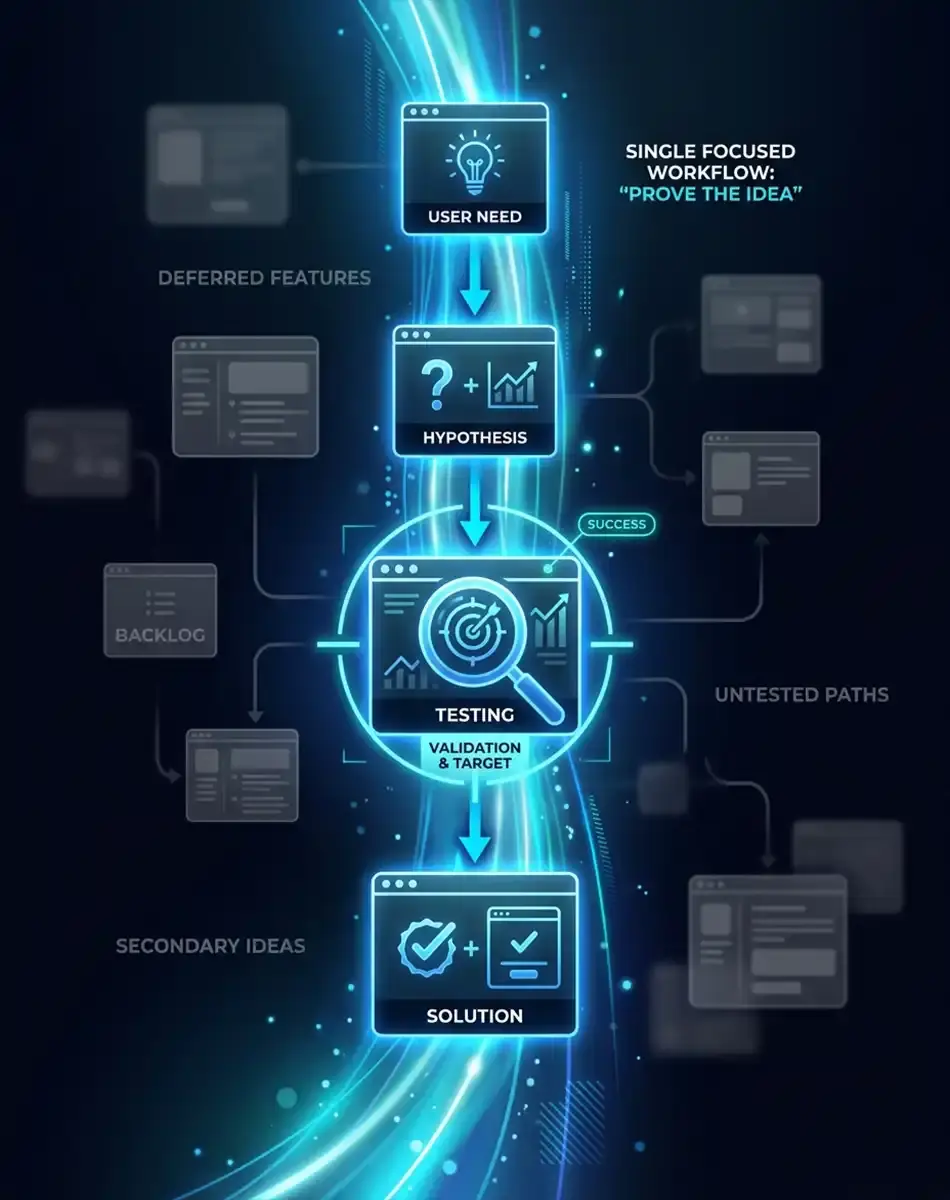
- Scope by hypothesis, not by feature list. Ship the one workflow that proves or kills the idea, make that workflow genuinely good, and leave everything else for later.
MVP vs. MLP: the short answer
What is an MVP? The minimum viable product is the simplest version of your product that still delivers the core value and allows you to test a particular assumption with real users. Its job is to learn, not to earn money.
What is an MLP? A minimum lovable product is a first release that’s scoped just as tightly but built to a standard where early users truly love it. It tests the same core assumption but also validates that the experience is good enough to keep people around.
Why this decision matters more in 2026
That change is good and bad. It’s easy now to produce a rough MVP, so it’s no longer distinctive or proves much. There are better options a tab away, so a bad first version can create a false negative: people leave because of the experience, not the idea, and you decide the idea was bad. That’s the central case for leaning toward an MLP in crowded or consumer-facing markets, a point explored in recent product-strategy discussions on the different types of MVP and which to build in 2026
When to build an MVP
- The market is new or uncontested. If there is no obvious alternative, users forgive rough edges to get the value you offer.
- You are testing feasibility or demand, not experience. You mainly need to know whether people want the thing at all.
- Your buyers are technical or pragmatic. Internal tools, developer products, and B2B workflow apps are often judged on whether they work, not on delight.
- The runway is very tight. When every week counts, the fastest honest test wins.
When to build an MLP
Lean toward an MLP when the experience is part of what you are testing:
- The market is crowded. When users already have polished options, a mediocre first impression reads as "worse," not "early.
- You are consumer-facing. Delight, trust, and design are key to adoption and word of mouth.
- Retention is the risky assumption. If your worry is not "Will they try it?" but "Will they stay?", you have to ship something worth staying for.
- Your brand cannot afford a weak debut.For some founders, the first version defines their reputation.
How to scope either one: validate a hypothesis, not a feature list
The most common scoping mistake is arguing about features. Features are the wrong unit. Scope around the single hypothesis the release must test.
- Write the one hypothesis. For example: “Fleet managers will pay to schedule EV charging from a phone. ” Everything in the release must support that sentence.
- Find the one workflow that proves it. Usually there is exactly one path a user must complete for the hypothesis to be answered. That path is your scope.
- Remove everything that is not part of that path. Settings, edge cases, admin panels, and nice-to-haves are deferred by default, not debated.
- Decide the quality bar (this is the MVP-vs-MLP call). For that one workflow, choose “works” or “delightful,” and be honest about which your market demands.
- Instrument the workflow. Decide up front what signal counts as validation, so the launch produces an answer rather than opinions.
Common mistakes founders make
- Shipping a wide, shallow product is a common mistake. Ten half-built features teach less than one finished workflow. Depth on the core beats breadth every time.
- Confusing “minimum” with “sloppy.” “Minimum” refers to scope, not to quality. Cutting the number of features is smart; cutting reliability on the feature you kept is not.
- Skipping instrumentation. A launch with no analytics produces stories, not data. You cannot validate what you cannot see.
- Over-polishing the wrong layer. Pixel-perfect onboarding for a workflow nobody has validated is wasted runway. Polish the core, not the periphery.
- Letting a cheap AI prototype become the production codebase is a mistake. A generated prototype is perfect for validation and dangerous as a foundation. Rebuild the parts that must scale on solid engineering, as covered in the pillar guide’s section on where AI helps and where it hurts.
Where Devsynth fits
If you want to see how a tightly scoped core workflow can still be production-grade across platforms, our EVDC case study is a good example: payment for EV charging sessions, done properly across web, iOS, and Android.
Frequently asked questions
What is the difference between an MVP and an MLP?
Should a startup build an MVP or an MLP first?
Has AI made the MVP obsolete?
How long should it take to build an MVP or MLP?
Can I turn my MVP into the real product later?
Ready to scope your first release?
If you are weighing how much product to launch with, talk to engineers who have shipped tightly scoped, production-grade first releases.